Written by a human through reciprocal interview and discovery with AI, and vice versa through symbiosis.
The Art of Living
Stop Planning Your Life. Play It.
The Art of Living, chapter 1. What if every unfinished job were a level you could clear, and the record of clearing it became the art?
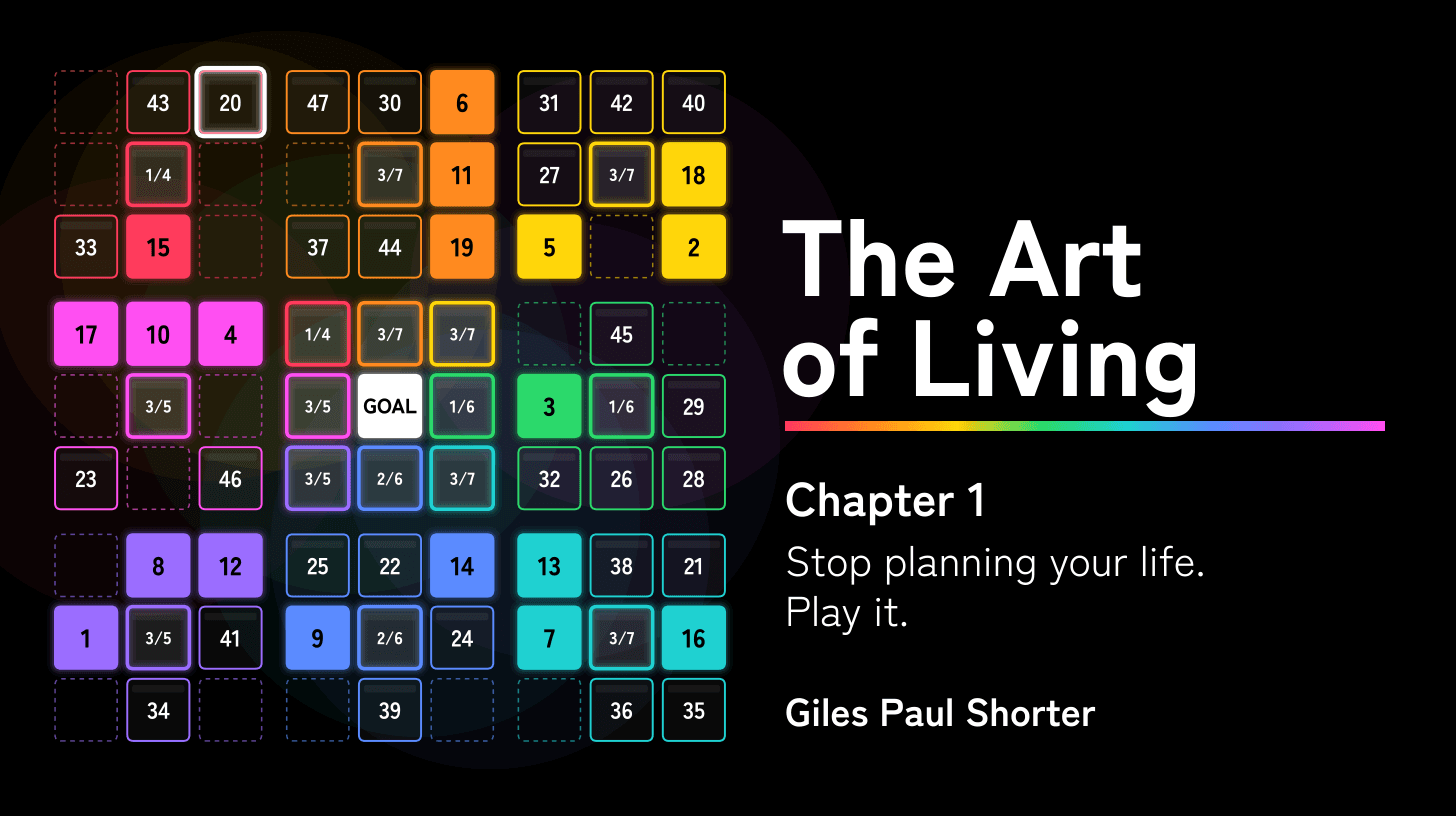
A note before we start. I wrote the first version of this chapter at six o'clock one morning this week. By the afternoon, the thing it described had been overtaken by the thing I'd built, so I've rewritten it. That speed is part of the story, and next week I'll show you exactly what changed, including the bit that went wrong.
One Monday this autumn I had six AI windows open at once, each one building something different.
By the evening I had moved six projects forward and finished none of them. Nothing I could sell, send or show anyone.
It felt like the most productive day of my year. It was also a failure. Both were true.
By the end of this essay I'll tell you what I changed the next morning, and why I think it could one day help fund my children's start in life. But first, something you have probably felt too.
You are not lazy. Your plan is.
You have a list. Probably several. An app, a notebook, a calendar that looks like a game of Tetris someone gave up on halfway.
You start strong on Monday. By Wednesday the plan has turned into a record of everything you didn't do, and every unticked box whispers that you're behind.
Sound familiar?
And have you noticed that your best days are rarely the planned ones? They're the days you got absorbed. The days that felt, almost, like play.
Here's my claim: the problem isn't your discipline. It's that you've been treating your life as a plan to obey, when it works far better as a game to play.
Surfing the wave of inevitability
Stay with me. This gets strange.
Six o'clock in the morning is my hour. The house is quiet, the kettle is on, and it's the only time my head is completely clear. It's when I think the thoughts I don't usually say out loud.
Here's one. I think of us as extraordinary machines: trillions of tiny moving parts, running on code we didn't write. I suspect a great deal of what we call choice is that code playing out, and that free will is less a steering wheel than a surfboard.
That's my view, not settled science, and you don't need to share it for the rest of this to work. But follow where it leads.
If much of life is a wave that arrives whether we like it or not, the question stops being "how do I control everything?" and becomes "how do I ride this well, and enjoy it?" I call it surfing the wave of inevitability.
You don't choose the wave. You choose how well you ride it.
Games already know how to make that ride fun. A good game gives you one clear objective, a visible next step, instant feedback, and a small moment of triumph each time you clear a level.
Your to-do list gives you none of those.
Everyone knows what normally hits the fan
So I've built a game. I call it FAN: Finish Anything Now. One morning it was a method. By that afternoon it was a working app.
We all know the phrase, and we all know what usually hits the fan. FAN flips it. You throw everything at it: the half-formed ideas, the abandoned plans, the business you keep meaning to start, the box of receipts, even Christmas. And instead of the usual mess, what blows back is a flurry of pound notes. Or at the very least, a stack of jobs marked done.
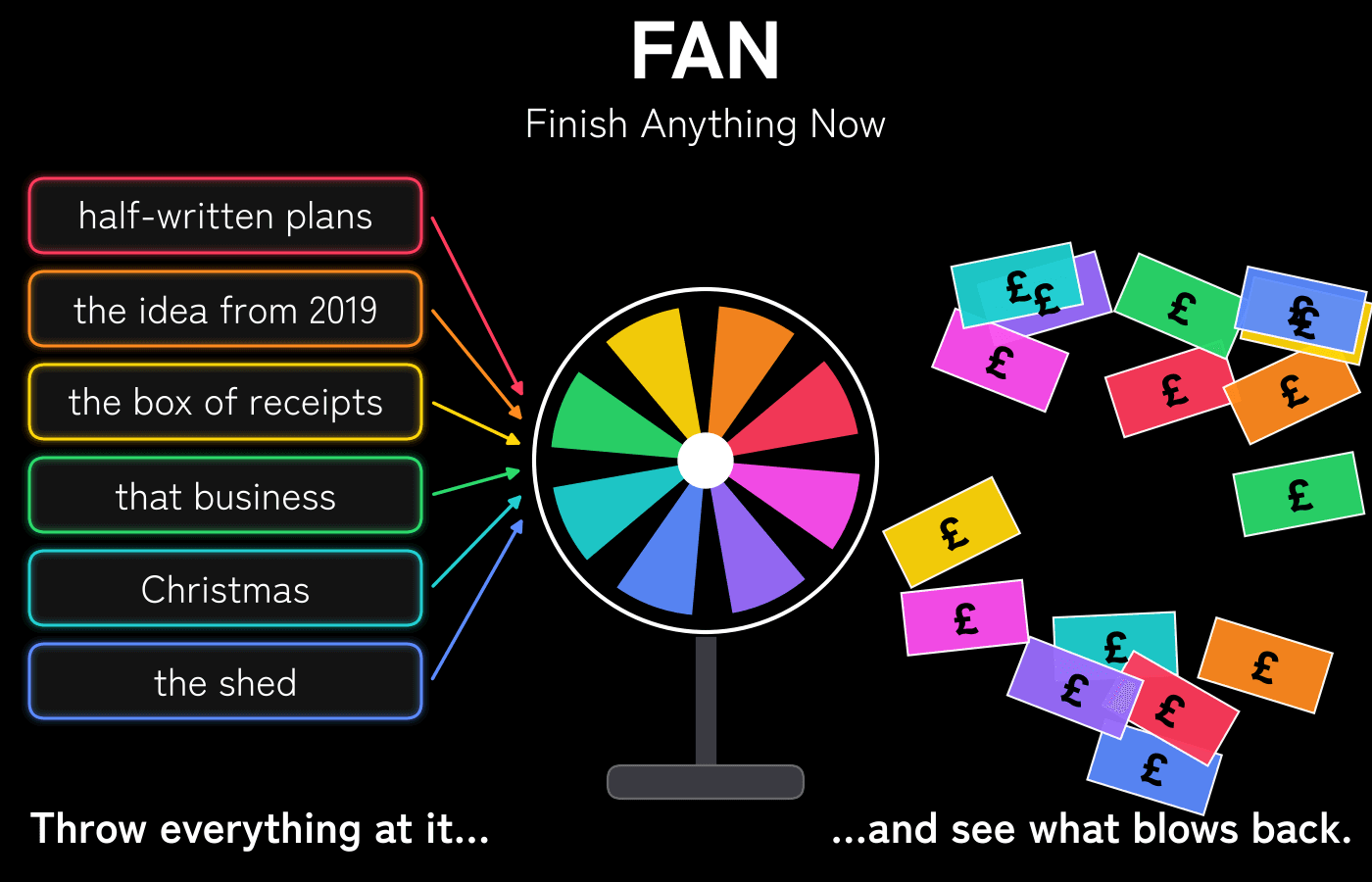
It runs on an old idea and a new partner. The old idea is a Harada grid, named after the Japanese coach Takashi Harada: one goal in the middle, eight areas around it, and up to eight small actions in each area. The baseball star Shohei Ohtani famously filled one in as a teenager. The new partner is AI.
What it feels like to play
You are not the input engine any more.
FinishAnythingNow runs in your web browser, on Claude. Here is what actually happens when you open it. The screenshots below use an invented example, a potter who wants to start teaching, so you can see each step clearly.
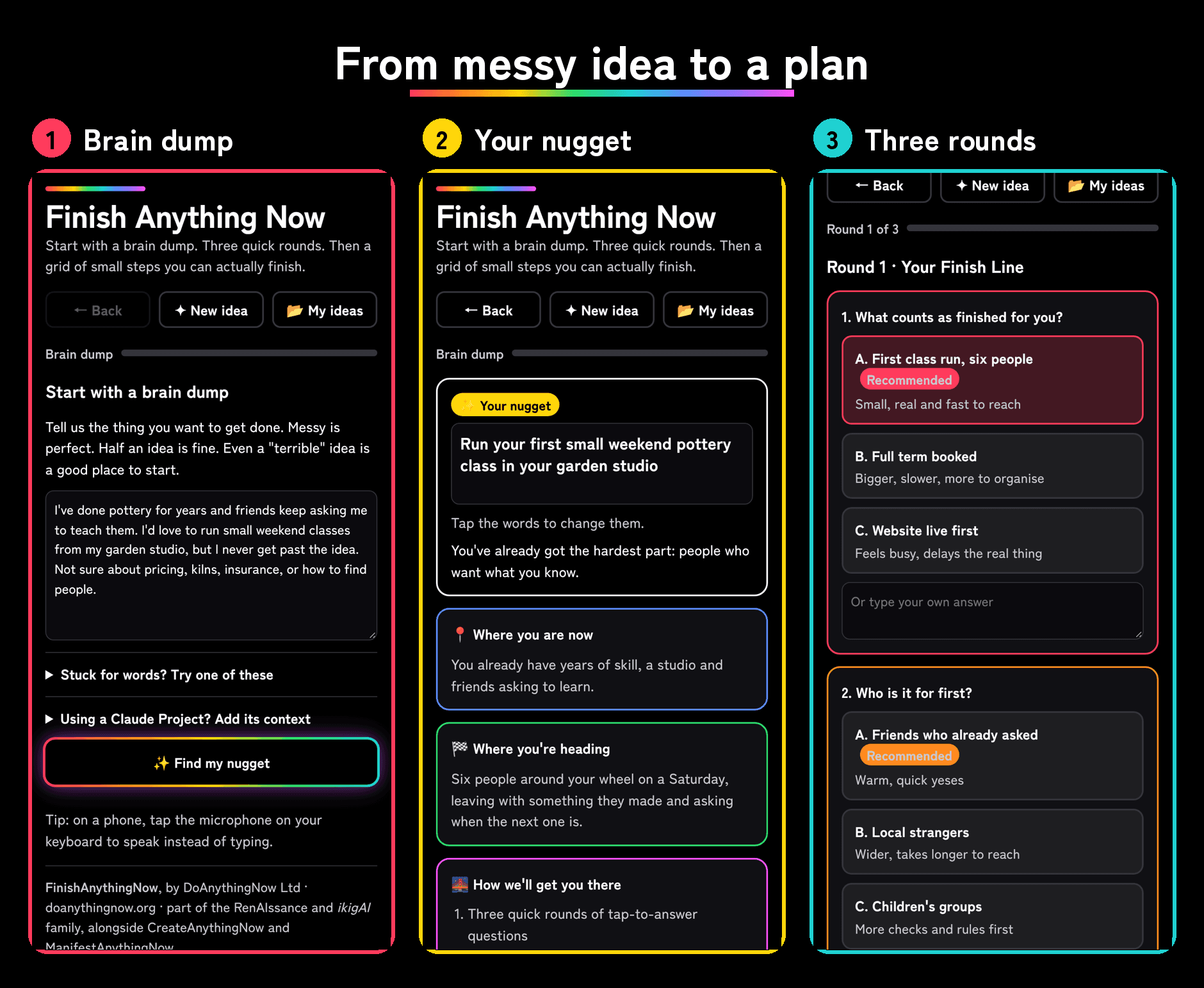
You start with a brain dump. Messy is perfect. Half an idea is fine. Type it, or tap the microphone and talk.
It finds your nugget. Out of the mess it pulls one sentence: the goal. Then where you are now, and where you're heading. If the words aren't quite right, you tap them and change them.
Then three quick rounds of questions. Your finish line. What you've got. Your first move. Each question comes with a few answers already written and one marked Recommended, so you tap rather than type. Stuck? There's a button that picks for you.
Your plan appears as a grid. One goal in the middle, up to eight areas around it, and between three and eight small steps in each. Not always 64 squares: a small goal might need twenty-four. Every square is numbered in the order that reaches your goal soonest, and the next one gently pulses.
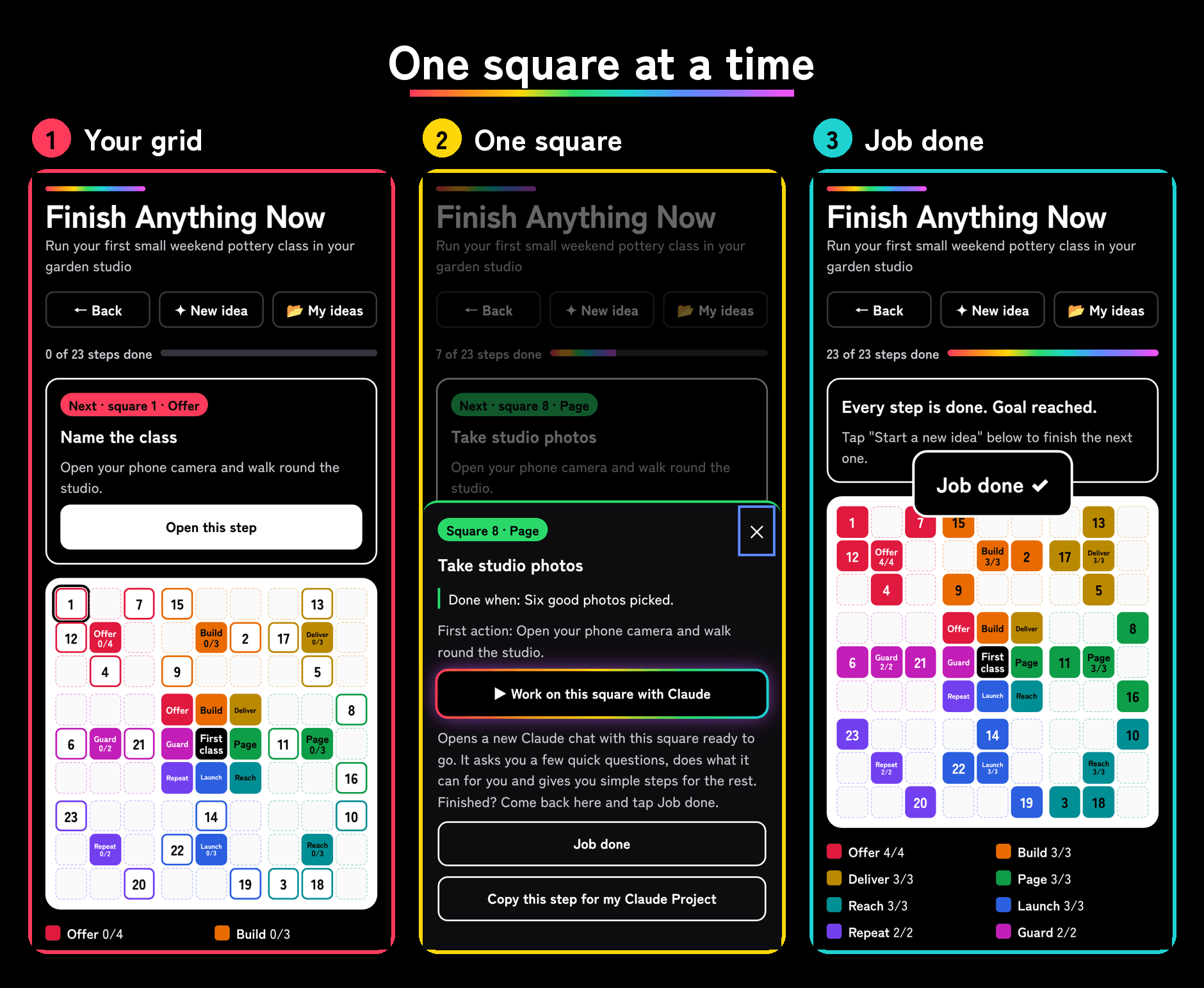
Every square is its own short conversation. Tap it and you see what done looks like and the very first thing to do. One button opens a conversation with Claude about just that square: it asks you the questions, does what it can itself, and hands you only the steps that need you.
It celebrates. Tap Job done and the confetti flies. Finish every square in an area and the whole area lights up. Finish the grid and, well, you'll see. The finish line isn't 64 squares away. It's one square away, every time.
It learns as you go. Life moves, and the plan should move with it. Every answer you give is meant to shape the next question it asks and the next square it lights up, so the right square is the one for today, not for the day you made the plan. Today you still give it a nudge to rethink; we're changing that so it happens quietly, by itself, as you answer.
Quietly, in the background, a set of checks keeps every answer honest and inside your own rules. You don't see them working. You just notice that it won't let you fool yourself.
The shift is small and total: you stop asking "what should I do today?" The grid already knows. One square lights up, and it's the only one you need to think about.
While you sleep
There's one more piece. While you work through a square, a system I'm building called Ebb & Flo keeps note of everything else your day touched: the screens you had open, the meetings in your calendar, the emails you sent.
At night it does what our minds do when we sleep. It sorts the day, tidies it, and works out what is finished and what is still open. In the morning you wake up to a short summary and a grid that has quietly caught up with your life.
The art of living
Every square you finish leaves a trace: a decision, a file, a line in tomorrow morning's summary.
Over the weeks those traces add up to something I didn't expect. A story. Not a diary I have to remember to write, but a story that writes itself from what I actually did.
That's what I mean by the art of living: recording your life so that the record becomes the art. Your days aren't the rehearsal for some masterpiece you'll make later. The days are the masterpiece. For the first time, we have the tools to see them as one piece of work.
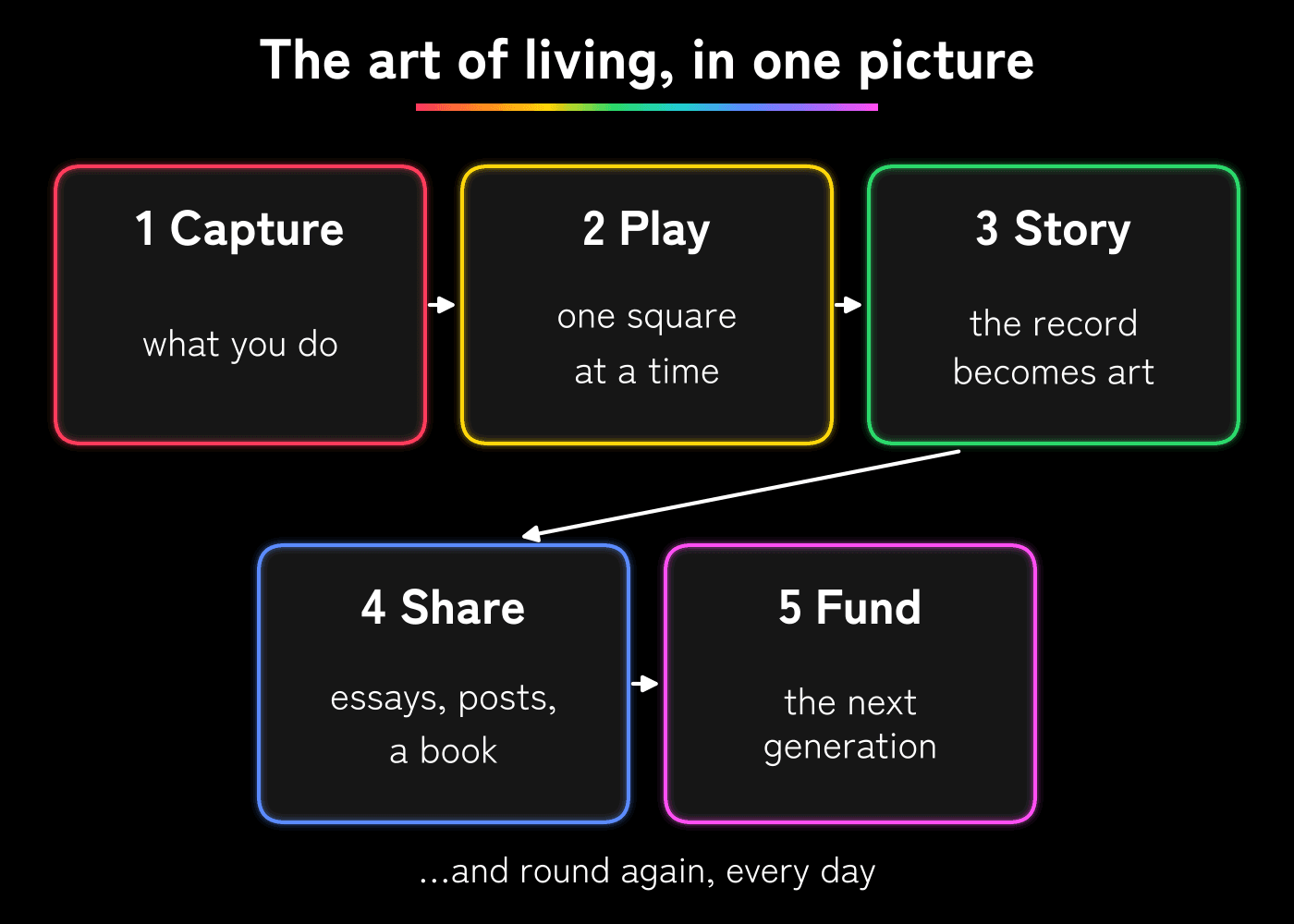
That last box is the one I care about most. My plan is simple: a share of everything the game earns goes straight into savings for my children, from the very first sale, so that compound interest can do its slow, quiet work for them over decades.
If it works for one family, I want to build it for founders' families everywhere. Founders funding founders: a system that gives a child a funded start before they're old enough to know it exists.
Your first square (try this tomorrow)
Any size of dream. One sheet of paper.
You can play the paper version right now. It's the same method I'm using for the money machine I'm building. (Not for Christmas, though. That story is next week.)
- Pick the one project you've been putting off. Any size. A business, a book, a move, a garage you can't open. The bigger the better.
- Write it in the middle square. That's your goal.
- Around it, write the eight things it needs. Money, time, skills, help, whatever fits.
- Around each of those, write the actions you can already see. Up to eight each. Leave blanks: they'll fill as you go.
- Number the first three in the order that gets you to the goal soonest. Do square 1 today. Then say "Job done" out loud. Feel slightly ridiculous. Notice what happens to the rest of your day.
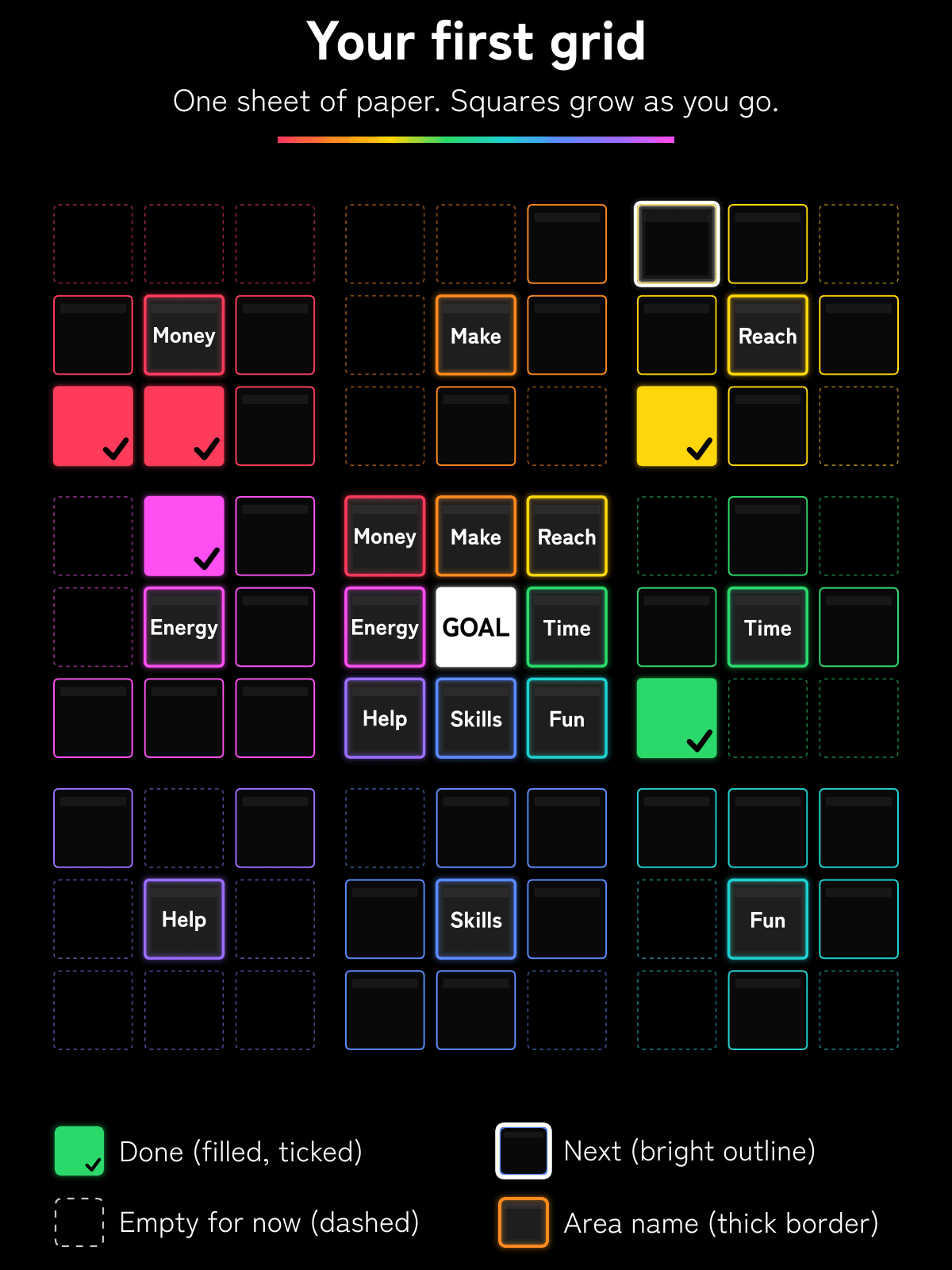
That's level one cleared. The giant project hasn't shrunk. It has just become a game you can see the end of.
The paper version gets you started. The AI version does the hard part for you: it asks the questions first, builds the grid with you, and keeps it alive.
"Isn't this just a to-do list in fancy dress?"
Fair question. A cynic would say gamification is a trick, and you'll tire of it in a fortnight like every app you downloaded in January.
Maybe. Here's the difference I'm betting on. A list judges you for what you didn't do. A game only counts what you did. A list waits for you to feed it. This one asks the questions. And the record that builds up isn't another chore to keep up with; it's simply what's left behind when you play.
Will that hold up over months? I don't know yet. That's exactly why I'm testing it in public, where you can watch.
Back to that Monday
Remember the six windows? The day that felt brilliant and produced nothing?
The next morning I set myself a different rule. One hour, first thing. One square. Then stop.
Right now I'm on square 21 of my own grid, playing against the clock to see whether a game built in days can earn its first pound without me chasing it. Square 21 is the moment of truth: a real test purchase, bought, delivered and refunded. It has taken me the best part of a day, and I'm nearly there.
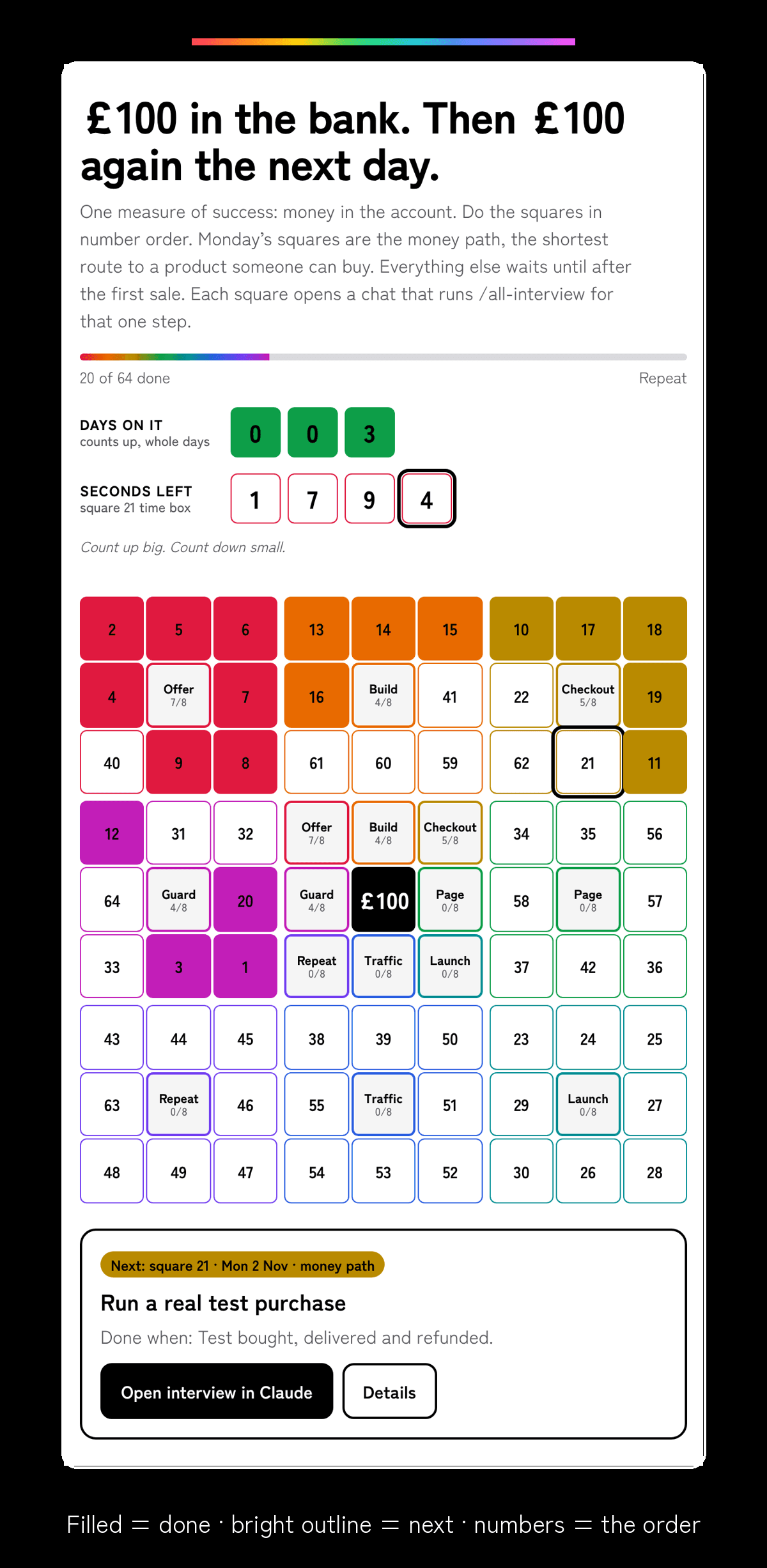
You'll see the result, square by square, later in this series.
But first, a confession. On the very day I built this, I threw our family Christmas at it.
It failed. And the reason it failed changed the first question the whole system asks.
In the next chapter I'll tell you exactly what happened, and the one question that fixed it.
Your turn. Tell me in the comments: what's the one thing in your life you'd most like to turn into a game? One word is enough. I'll read every answer, and the best ones will shape the chapters to come.
If you want to know what went wrong at Christmas, subscribe. It's free, and chapter 2 comes straight to your inbox.
And if you know someone who starts everything and finishes nothing, send them this. They'll know why.